
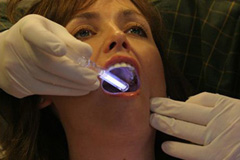
We now know that oral cancer claims one life every hour in the U.S.--- more than the number of lives lost to skin cancer, cervical cancer or Hodgkin’s disease, and it is of great concern to Dr. Del Puerto because early detection is the key to successful outcomes, our practice has incorporated ViziLite Plus. ViziliLite has become the new standard in detecting oral cancer.
ViziLite Plus is a simple, and non-invasive technology that improves the doctor's ability to visualize, mark, evaluate and monitor suspicious areas at their earliest stages, before they can progress to something far more serious, and potentially life-threatening. ViziLite Plus helps Dr..Del Puerto see what you can't see with the unaided eye.

Oral cancer is a dangerous, yet somewhat preventable, type of cancer. It kills more people nationwide than either cervical or skin (melanoma) cancer, and only half of all patients diagnosed will survive more than five years. The most common risk factors for oral cancer are tobacco use, frequent high quantity alcohol consumption, constant sunlight exposure, habitual cheek or lip biting, or poorly fitting dentures. Although 80-90% of oral cancers are found in people who use tobacco and/or drink alcohol excessively, 25% of oral cancers occur in people who have no risk factors at all.
Statistics show in about 10% of patients, dentists notice a problem area first. During your periodic dental examination, Dr.Del Puerto will examine your entire mouth, searching for a flat, painless, white or red spot or small sore. Other signs of oral cancer can include:
- A sore that bleeds easily or does not heal
- A color change of the oral tissues
- A lump, thickening, rough spot, crust or small, eroded area
- Pain, tenderness or numbness anywhere in the mouth or on the lips.
Two different tests are used to determine if the spot is cancerous or not. A brush biopsy is a painless test performed on areas that look harmless or do not have a clear cause. This test can detect potentially dangerous cells when the disease is still at an early stage. A scalpel biopsy, which requires local anesthesia, is usually performed on suspicious and dangerous looking areas. Remember to visit your office regularly. If you notice any unusual changes in your mouth, call our office immediately. Together we can fight and win the battle against oral cancer.